
Mozaic Component Technology · Media
Seagate Gen 2 superlattice platinum-alloy media
Combating magnetic instability at the nanoscale
Engineered to combat magnetic instability at the nanoscale, our Gen 2 superlattice platinum‑alloy media packs highly stable nanoparticles more densely for higher capacity and scalable production.
Each nanoparticle only a few nanometers in size acts as an individual bit
Magnetic orientation remains steady over time, keeping each bit unaltered
Bits placed together more densely than in any other hard drives in history
Improves efficiency while maintaining — often increasing — areal density
How does FePt superlattice media store data more densely than PMR?
Designed for denser, more stable data storage.
Seagate’s second‑generation superlattice platinum‑alloy media improves efficiency while maintaining — and in many cases increasing — areal density.
Highly stable magnetic nanoparticles, each acting as a single bit of data, can be packed closer together than in conventional PMR drives or earlier Mozaic™ generations. The result is greater data stability and stronger resistance to thermal fluctuations, enabling higher capacity without compromising reliability.
Its essence lies in the use of platinum (Pt) and iron (Fe) particles. Within the superlattice platinum-alloy media, each nanoparticle, only a few nanometers in size, acts as an individual bit of data.
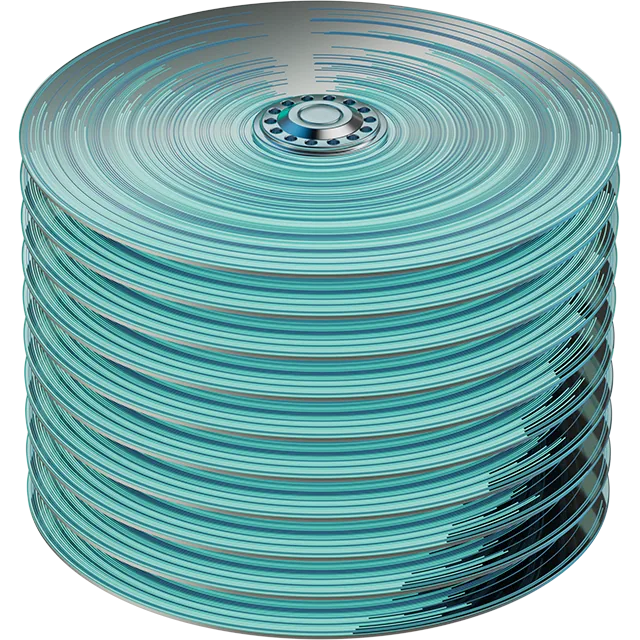
How does high magnetic anisotropy in FePt superlattice media keep bits thermally stable?
Three properties of the media that together allow bits to be packed closer without losing them to heat.
High Magnetic Anisotropy
This fine granularity is made possible by the media’s high magnetic anisotropy — the magnetic orientation of the material remains steady over time, ensuring that each bit is stable and unaltered by the writing of adjacent data.
Predetermined Orientation
The media’s unique magnetic alloys favor a predetermined magnetic orientation. This is key to stabilizing the magnetic state of individual bits, thereby reducing their susceptibility to thermal fluctuations.
Record Areal Densities
Its high magnetic anisotropy provides the stability needed for recorded bits achieving record areal densities — bits that are placed together more densely than in any other hard drives in history.

How is Seagate’s FePt superlattice media manufactured with epitaxial growth at volume?
Achieving order within the media involves sophisticated manufacturing.
Epitaxial growth is used to deposit FePt thin films on crystalline underlayers on a special glass substrate. These underlayers serve as a template, dictating the orientation and ordering of the FePt grains during the deposition process.
Subsequent annealing at high temperatures further promotes ordering in the FePt grains, leading to a phase transformation that enhances the media’s magnetic properties and grain alignment.
This intricate and carefully controlled process provides a robust, stable platform for high-density data storage — and, critically, one that scales to volume production rather than remaining a laboratory result.
Why is FePt superlattice media the foundation of Mozaic 3+ capacity and reliability?
The media is the surface every other Mozaic component exists to serve. The plasmonic writer heats it, the spintronic reader senses it, and the controller positions over it.
Because the nanoparticles have such high magnetic anisotropy, they resist the thermal fluctuations that would otherwise flip a bit as bits get smaller. That is what allows greater data stability alongside higher capacity, rather than trading one for the other.
The result: higher capacity without compromising reliability, on a platform that improves efficiency generation over generation.
Why areal density matters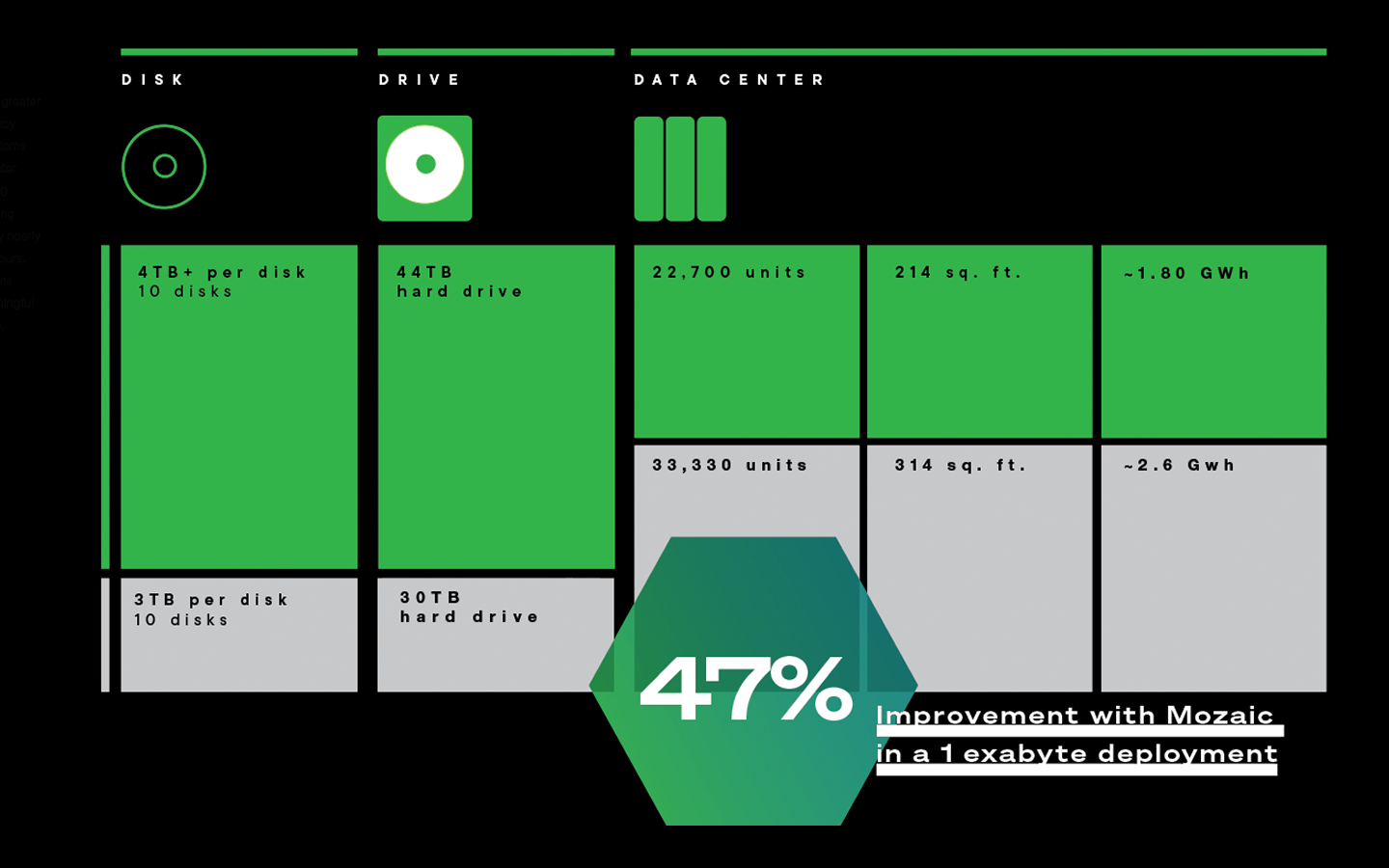
How does FePt superlattice media work with the plasmonic writer, spintronic reader and 7nm controller?
Mozaic is not one invention. It is four component technologies engineered in-house to work as a system.
Seagate’s documentation on FePt superlattice media and Mozaic 3+
The platform these components add up to, and what it delivers.
Gen 2 superlattice media: frequently asked questions
What the recording layer is made of, and why that determines how much a drive can hold.
Engineered to combat magnetic instability at the nanoscale, Seagate’s Gen 2 superlattice platinum-alloy media packs highly stable nanoparticles more densely for higher capacity and scalable production. It improves efficiency while maintaining — and in many cases increasing — areal density.
Its essence lies in the use of platinum (Pt) and iron (Fe) particles. Within the superlattice platinum-alloy media, each nanoparticle, only a few nanometers in size, acts as an individual bit of data.
High magnetic anisotropy means the magnetic orientation of the material remains steady over time, ensuring that each bit is stable and unaltered by the writing of adjacent data. It provides the stability needed for recorded bits achieving record areal densities.
Highly stable magnetic nanoparticles, each acting as a single bit of data, can be packed closer together than in conventional PMR drives or earlier Mozaic generations. The result is greater data stability and stronger resistance to thermal fluctuations, enabling higher capacity without compromising reliability.
Epitaxial growth deposits FePt thin films on crystalline underlayers on a special glass substrate. These underlayers serve as a template, dictating the orientation and ordering of the FePt grains during deposition. Subsequent annealing at high temperatures further promotes ordering, leading to a phase transformation that enhances the media’s magnetic properties and grain alignment.
The media’s high magnetic anisotropy is exactly what makes it stable — and also what makes it hard to write. The Gen 2 plasmonic writer heats specific nanoparticles to temporarily lower their magnetic resistance so data can be written with reduced magnetic field strength, then they return to their stable state.
Yes. The second-generation media is designed for scalable production, and the intricate but carefully controlled deposition and annealing process provides a robust, stable platform for high-density data storage at volume.
BlueAlly (DiskDataWorks.com) is an authorized Seagate reseller for the Exos enterprise portfolio. Call 844-356-5142 or request a quote online.
What does nanoscale magnetic stability mean for your Exos capacity and power budget?
Our experts can help you find the right solution. Talk to a BlueAlly solution architect about deploying Mozaic-powered Exos drives — and what nanoscale magnetic stability means for your capacity and power budget.
No-cost architecture assessment
Capacity-per-rack-unit and watts-per-terabyte modelling
Validated Exos configuration for your workload
Flexible procurement — CapEx or OpEx
Talk to an Expert
with a BlueAlly Solution Architect