
Authorized Seagate Reseller

Call a Specialist Today! 844-356-5142

Case Study · Factory AI Innovations

GitHub Copilot in Seagate’s factory software development

Authorized Seagate Partner · Competitive Pricing · Proven at Scale

Seagate started a multiphase plan to integrate generative AI capabilities into its factory-based software development. · 7 minute read

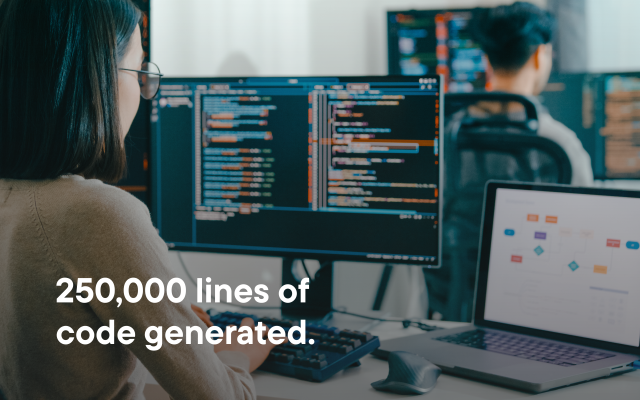
Software engineer at dual monitors of code with the statistic 250,000 lines of code generated
250Klines
Code Auto-Generated

Nearly 250,000 lines of code auto-generated by GitHub Copilot over six months

30developers
Coders On Board

30 developers now use GitHub Copilot, streamlining coding workflows

~30%efficiency
Soaring Efficiency

Nearly 30% efficiency improvement in software development

6months
Time Frame

Results achieved over a range of six months across factory IT

Software engineer working at dual monitors of code with a laptop showing a flowchart

Why did Seagate’s Factory IT team apply gen AI to software development?

Seagate's Global Factory IT team started an initiative to gain value in its manufacturing operations through applying AI. The team took the opportunity to focus on software development, using AI to help move past traditional processes and optimize Seagate's manufacturing IT solutions in real time. They selected GitHub Copilot, an AI-powered tool developed by Microsoft and OpenAI, to boost efficiency, code quality, and productivity.

The team immediately identified several key technical requirements: seamless integration of GitHub Copilot and gen AI tools with existing systems; developer training to effectively use these tools; robust data security and privacy measures for sensitive code and proprietary information; and a system to measure performance metrics to assess key performance indicators.

The goal: AI-driven pair programming to improve factory software coding efficiency.

Immediate needs included creating real-time code suggestions, adapting to developers' coding styles, and reducing cognitive load. The team also needed a tool that allowed for easy review, as developers were still encouraged to review the generated code to ensure it met their projects' specific requirements and standards.

Long-term goals include improving code security and reliability, aiming for a 50% reduction in rework; boosting developer productivity and efficiency, targeting a 20–50% reduction in development time through reduced manual coding; and continuing to modernize legacy code, focusing on risky code migration (e.g., JavaScript to Angular/JS, Visual Basic to C#) while minimizing business risks.

What limited Seagate’s legacy, manual code development?

Before the new initiative, Seagate's Global Factory IT team used more traditional methods. Code generation was done manually, leading to inefficiencies and inconsistencies. Code quality was ensured through manual reviews, which depended heavily on the reviewer's expertise and were not foolproof. Developers had to continuously learn new languages and frameworks, slowing down development speed and productivity.

Maintaining legacy systems involved dealing with outdated code, which was resource-intensive and could lead to technical debt—the implied cost of future reworking, as speed is often a priority over long-term design effort. These traditional methods, while somewhat effective, were often resource-intensive, time-consuming, and could not fully eliminate errors or inefficiencies.

Developer in glasses looking at a screen with lines of code overlaid

How did Seagate roll out GitHub Copilot across factory IT?

Integrating GitHub Copilot into Seagate's Global Factory IT software development workflow has shown promise in optimizing processes, delivering business value, and setting industry standards. The team divided the project into three phases.

Phase 1
Initial adoption

Implement GitHub Copilot for core developers and provide training. Measure the reduction in development time for routine tasks. Phase 1 has already demonstrated early benefits.

Phase 2
Ramp-up

Improve overall development productivity by 20–40% and achieve a code/chat acceptance rate of over 30%, with semi-automated unit testing and improved documentation efficiency.

Phase 3
Full implementation

Fully implement GitHub Copilot and track key metrics for continuing success—optimizing resource allocation for value-adding projects and aiming for greater output with the same or fewer resources.

Hand using a stylus over a laptop with a holographic document checklist marked with blue checkmarks

What did 250,000 Copilot-generated lines of code deliver?

Efficiency has improved with automated code generation, speeding up task and project completion. Code quality has also been enhanced, with better reliability and security due to automatic vulnerability detection and quality assurance. Developer productivity and innovation have increased as developers focus more on strategic tasks and creative problem-solving.

Over 30 developers now use GitHub Copilot as the first "AI pair programmer," streamlining coding workflows. Factory IT professionals utilized GitHub Copilot to generate more than 250,000 lines of code, with nearly 30% seamlessly integrated into their solutions. The business impact extended beyond individual developers to the entire IT ecosystem, with increased productivity translating into faster feature delivery and reduced time-to-market.

"Seagate's Global Factory IT team integrated GitHub Copilot, boosting software development efficiency by nearly 30% and generating over 250,000 lines of code in six months. This initiative enhances coding quality and sets a new standard for AI-driven development in manufacturing."

David Gu
Senior Director, Global Factory IT

Advice for other organizations: Chong Khee (CK) Tan, senior manager of Global Operations IT, recommends evaluating use cases to identify where gen AI can have the most impact, starting with a small project to assess effectiveness, addressing ethical concerns like bias, privacy, and security, and upskilling teams while fostering a learning and iterative environment. "Thoughtful planning and adaptation maximize gen AI's benefits," Tan advises.

BlueAlly Authorized Seagate Reseller

How does Seagate’s gen-AI engineering reach the drives you buy?

The gen-AI-augmented engineering that modernizes Seagate's own factories is the same culture of innovation behind every drive it ships. BlueAlly helps you put that portfolio to work—Exos, Mozaic and more—in your data center.

We've developed a partnership with Seagate that lets us compete at the highest level on price and service. That translates into the widest range of in-stock products, fast shipping, and the advice of certified product experts—without the pain of premium pricing. If you need additional guidance in sourcing the right product, our team can bring you together with the presale engineering team.

Innovation-led engineering
Full Exos & Mozaic portfolio
In-stock products, fast shipping
Flexible procurement — CapEx or OpEx

Our wealth of experience in transformational IT drives government, regulated industries, Fortune 500 companies, and businesses of all sizes across the United States.

Operating out of strategic centers across the US, BlueAlly runs:

Support Desk
24/7 Security Operations Center (SOC)
Integration Center — hardware warehousing
DiskDataWorks.com is a part of BlueAlly

Augmented code development: frequently asked questions

How Seagate applies generative AI to factory software development.

Request a validated Exos and Mozaic configuration

The innovation-led engineering behind Augmented Code Development is part of what makes Seagate drives trusted at scale. Talk to a BlueAlly solution architect about the right Seagate configuration for your environment.

Full Exos, Mozaic & enterprise portfolio

Validated configurations for your workload

Authorized-reseller pricing

Flexible procurement — CapEx or OpEx

Talk to an Expert

with a BlueAlly Solution Architect